
Sabiá Center launches study on public policies aimed at transforming territories
By Darliton Silva
Communicator for the Sabiá Center and the Northeast ATER Agroecology Network
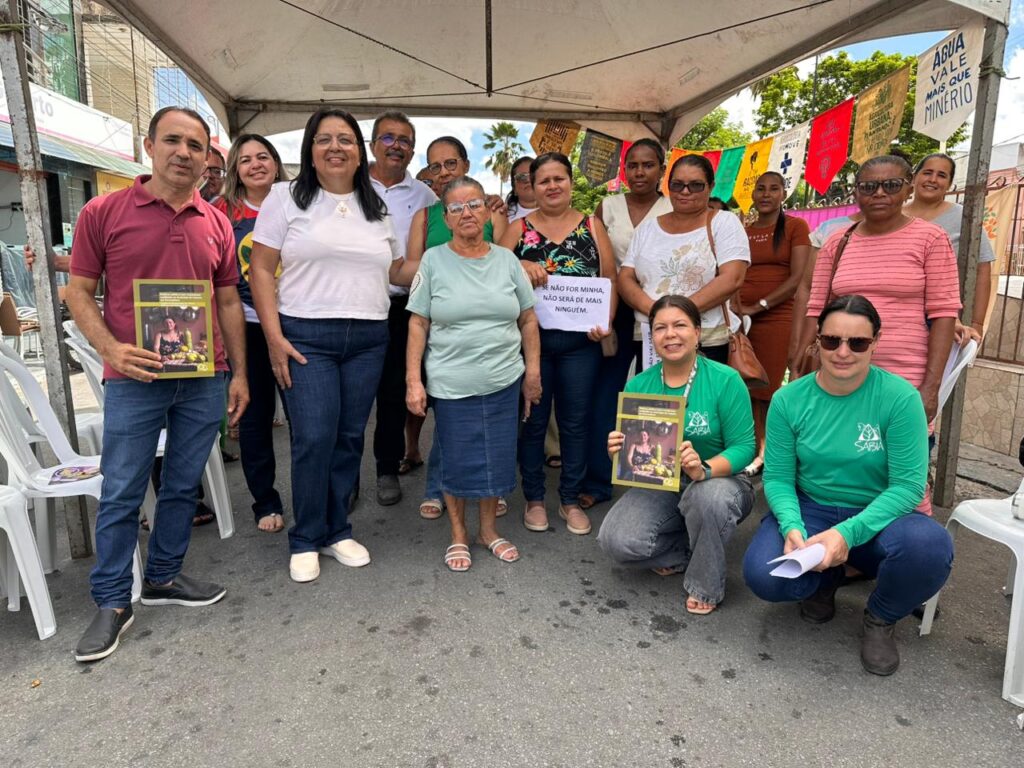
As part of the Northeast Agroecology ATER Network, the Sabiá Centre has strengthened the organizational capacities of family farming, encouraging formal and informal groups, especially peasant women, to act as protagonists in agroecological transition processes in their territories.
It is in this context that the municipality of Cumaru, in the Agreste region of Pernambuco, hosted, on Friday (20), the launch of the booklet “Public Policies to Transform Realities in the Municipality of Cumaru, Pernambuco”.. The activity brought together around 40 women, as well as representatives of the local government, in a space for dialog about rural development and strengthening agri-food systems.
The publication presents the main results of a case study carried out in the municipality between August 2024 and April 2025. The research analyzes local agri-food systems, focusing on the dynamics of production, marketing and access to public policies.
The study was conducted by the Sabiá Agroecological Development Center and is part of the Cultivating Futures project : a just agroecological transition in agri-food systems in the Brazilian semi-arid region. The publication seeks to contribute to the construction of strategies that promote sustainability, social justice and food security in Cumaru.
For Elizabete Monteiro, Cumaru’s Secretary for Social Assistance and Women’s Affairs, the municipality has benefited greatly from the research carried out with local farming families and the launch of the booklet during the town’s Agroecological Fair. The publication contributes to broadening the municipal administration’s view of the importance of qualification and proper implementation of public policies. “The study carried out in partnership with the Sabiá Center highlights the trajectory of local women farmers and reinforces the importance of women’s work in family farming, with the production of healthy food,” says Monteiro.

The Sabiá Center has been working since 1993 to promote family farming in Pernambuco, combining agroecological practices with the fight against hunger in the state. Throughout this period, the institution has developed initiatives aimed at strengthening rural communities and building fairer and more sustainable food systems.
According to Juliana Peixoto, Centro Sabiá’s territorial coordinator, public policies and access to local markets play a central role in these transformations. “Changes in eating habits are linked to access to income, culture and the availability of food in the territory,” said Peixoto.
During the event, women farmers, market vendors and public managers shared their experiences, knowledge and stories of struggle, highlighting the challenges faced in the territory and the progress made over the years. The stories revealed the leading role of women in family farming, in the local economy and in the construction of public policies, as well as reinforcing the importance of women’s participation in decision-making spaces and social organization.
According to Maria Lourdes da Silva Pereira, a farmer and market vendor in the municipality, she has been accompanied by the Sabiá Center for around 30 years. During this time, she began to adopt more appropriate management practices after taking part in activities and exchanges. “Before Sabiá, we used to burn the crops and apply poison to corn, beans and vegetables,” Lourdes recalls.

The Cultivating Futures project is the work of AS-PTA, Bread for the World (Brot für die Welt) and the Northeast Agroecology ATER Network, with funding from the German Federal Ministry of Food and Agriculture (BMEL). Through the Network, the initiative is being developed in the states of Bahia, Ceará, Paraíba, Pernambuco, Rio Grande do Norte and Sergipe.
The initiative is a political advocacy action aimed at transforming food systems in Brazil and Germany, based on the exchange of knowledge between the two countries. It is an international cooperation experience that demonstrates how local solutions can contribute to tackling global challenges.
Nothing found.