

Youth on the move at the 3rd CNDRSS in Brasilia
By Sival Fiuza, a graduate in Literature from UFRPE/UAST, a young agroecology multiplier and member of the Youth Network of the Semiarid Latin America Platform, and Roseane Alves, an agricultural technician by training, an academic in Pedagogy, a teacher and an advocate of agroecological family farming
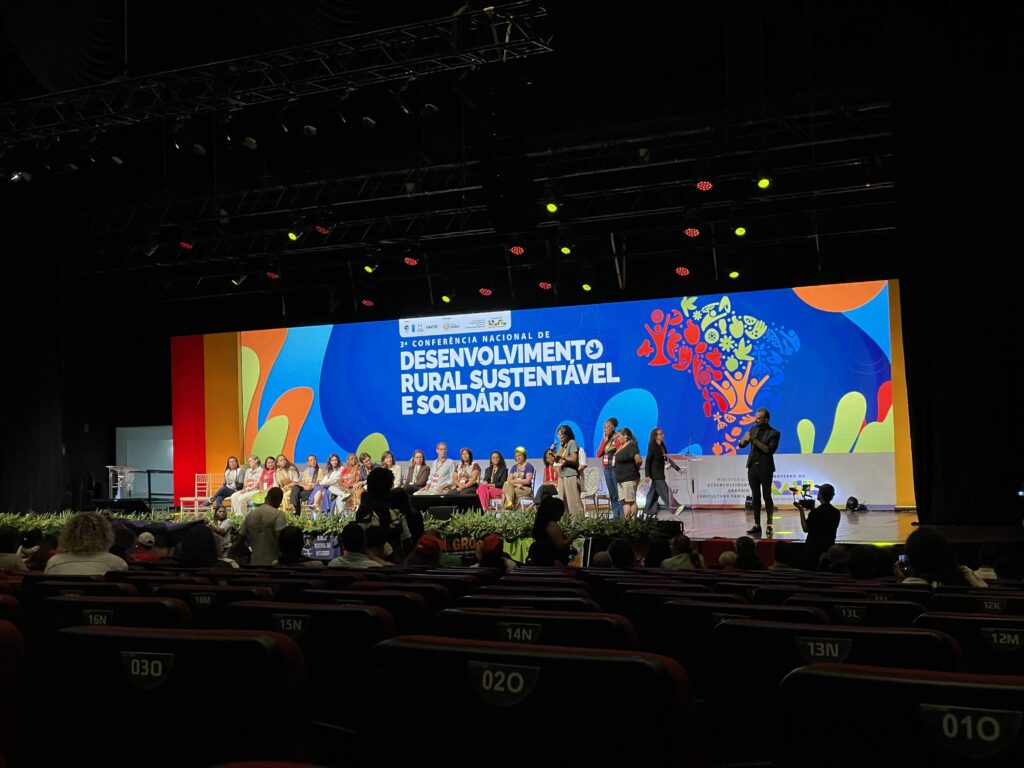
Between March 24 and 27, Brasilia became the center of debates on the future of rural Brazil during the 3rd National Conference on Sustainable Rural Development and Solidarity (3rd CNDRSS). The event brought together representatives from all over the country: family farmers, rural, water and forest peoples, social movements, researchers and, very significantly, rural youth.
Throughout the four days of intense programming, debates, plenary sessions and Working Groups (WGs) were held to discuss fundamental proposals for strengthening public policies aimed at sustainable rural development in Brazil. The conference reaffirmed its role as a democratic space for collective construction, where different voices meet to think about fairer, more inclusive and sustainable paths for the country.
The participation of young people was a highlight of the event. Young people from different regions of Brazil occupied the decision-making spaces, contributing proposals, experiences and perspectives that reinforce the importance of rural succession, of staying in the countryside with dignity and of building a future based on agroecology and social justice. The CJMA (Commission of Young Agroecology Multipliers) took part in the debates, especially in two important spaces:
Axis 1 – Strengthening Family Farming, Agroecology and Climate Change
WG 03 – ATER, research and innovation for the agroecological transition. This group discussed strategies to consolidate the National Policy for Technical Assistance and Rural Extension (PNATER), strengthen SUATER and promote applied research, environmental education and the development of social technologies adapted to different biomes.
Axis 5 – Citizenship and well-being in the countryside, waters and forests
WG 11 – Rural education and technical training. The debate highlighted education as a fundamental right, from literacy to higher education, and as essential to guaranteeing the permanence of young people in the countryside and strengthening rural succession.
Sival Fiuza, a delegate elected at the youth sector stage, representing the CJMA and Brazilian youth from the countryside, waters and forests, says: “We are the fruit of a rural Brazil that resists every day. A Brazil that plants, cares for, preserves and feeds. A Brazil that believes in agroecology as a way of life, as a practice of caring for the land and for people. It is in this context that our participation in the working groups, especially in the debate on ATER, research and innovation for the agroecological transition, reinforces that there is no possible future without investment in knowledge, social technology and the strengthening of communities.
The fight against climate change directly involves valuing family farming and the agro-ecological transition. There is no climate justice without social justice. And we are here to say that we will not accept setbacks. We will remain firm, organized and on the move.”
In the same vein, the delegate elected at the youth sector stage, Roseane Alves, reinforces: “rural Brazil occupied Brasilia between March 24 and 27 to show the strength of an organized people who don’t shy away from struggle. Rural Brazil is not predatory agribusiness; it is the family farmer who supplies the PNAE and PAA, the housewife who tends to her productive backyard and guarantees real food on her family’s table, the agro-ecological farmer who no longer accepts that food arrives on his plate with poison and GMOs.
It is inspired by the strength of these people that the movement does not stop: the struggle continues and must continue. Rural Brazil wants a fair country, free from the misogyny that oppresses us so much, free from all forms of oppression. That’s why it’s so important that we fight, that our voices echo more and more for freedom and parity. This is the struggle of so many movements that give us a voice, such as the CJMA, which invited me to get to know family farming through new eyes and made it possible for me to occupy this space at such a great conference, great because of its strength, because of the historic moment we are living through and because we have a human leader who is sensitive to our cause, such as President Lula.
We are unspeakably proud to be experiencing this unique moment in the agroecological transition in our country. United, we will overcome the challenges that arise.
We will not be silent, we will not back down! Long live rural Brazil, long live agroecology!”
The 3rd CNDRSS reaffirms that there can be no rural development without the active participation of young people. It is they who bring innovation, continuity and political strength to ensure that the countryside, waters and forests remain alive, productive and sustainable for generations to come.
Nothing found.