


Technical assistance for urban agriculture: what do we have?
By Simone Arimatéia
Technical advisor for urban agriculture at the Sabiá Center
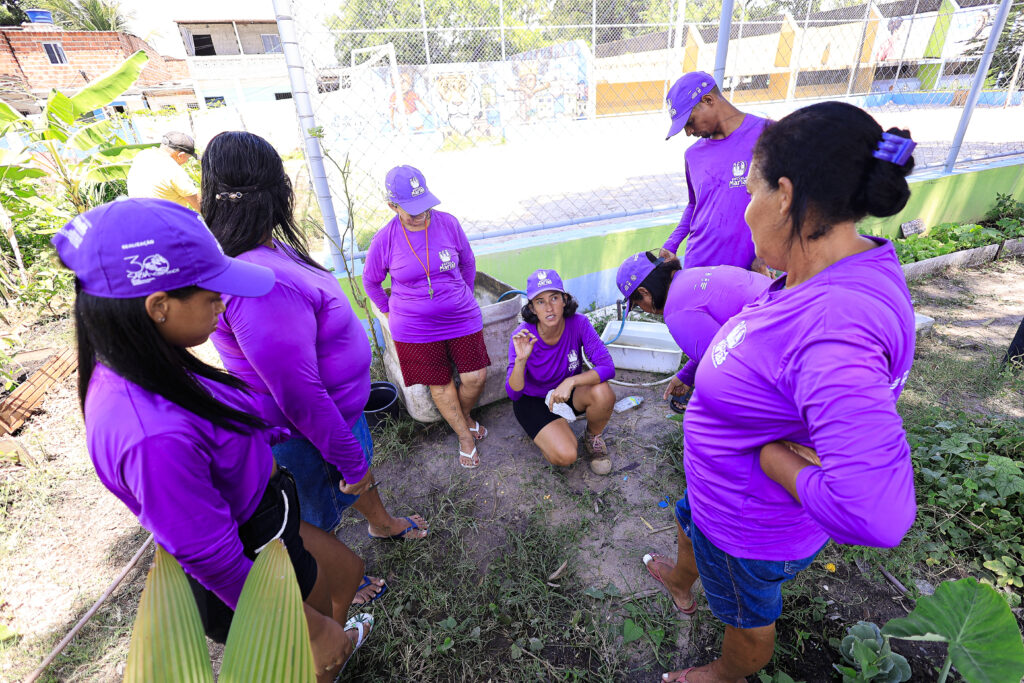
In Brazil, Technical Assistance and Rural Extension began to develop in the 1940s, but it wasn’t until 2010 that the National Policy for Technical Assistance and Rural Extension (Pnater) was created, with the aim of promoting access to quality services for family farmers and rural communities and strengthening their autonomy.
The growth of cities, verticalization and the decrease in backyards and arable land in urban centers have led to the emergence of collective planting spaces, urban gardens. During the Covid-19 pandemic, the number of productive gardens and backyards has increased due to the need on the outskirts for community green spaces and food production.
In 2023, the Federal Government created the Productive Backyards Program, with the aim of promoting food and nutritional security and the economic autonomy of rural women, through access to technical advice, inputs and equipment. The program also includes women who live in peri-urban areas, i.e. near cities.
In 2024, a law on urban agriculture was created. Law 14.935 instituted the National Urban and Peri-urban Agriculture Policy, aimed at promoting food security and the sustainable use of urban spaces for food production. Its main objectives are:
- Increasing food security for vulnerable populations;
- Occupying idle urban spaces for food production;
- Generate income alternatives and occupational activities for public supply, such as schools and hospitals;
- Promoting environmental education and agroecological production in cities;
- Encourage work in cooperatives and associations focused on urban agriculture;
- Promote recycling and the use of organic waste in agriculture.
Despite not being regulated, urban technical assistance has been provided by NGOs all over the country. This year, the Federal Government, through the Ministry of Development and Social Assistance, Family and Fight against Hunger (MDS) will implement social technologies for food production in small urban and rural spaces. Sisteminha Embrapa will be implemented in 20 cities across Brazil, with the aim of strengthening food and nutritional security in urban communities. The NGOs will be responsible for implementing the technologies, such as chicken coops, fish farming, worm farms, composting and vegetable gardens, and providing technical assistance. This will be the first action in line with the National Urban and Peri-urban Agriculture Program (PNAUP), which provides technical assistance for urban areas.
Nothing found.